

Granola: The Original Clean Eat, Done Right
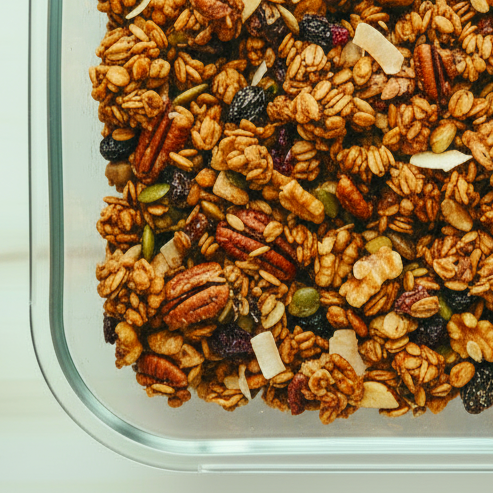
Most people have a complicated relationship with granola. They love it, but they've been burned by it — hidden sugars, mystery oils, a "health food" label on something that eats like a candy bar. When it's made well, though, there's almost nothing better.
The Problem With Store-Bought (And Why It Matters)
Walk down any grocery store aisle and you'll find dozens of granola options, almost all of them marketing some version of "wholesome" or "natural" or "clean." Flip the bag over, and the ingredient list tells a different story — high-fructose corn syrup, refined vegetable oils, artificial flavors, and enough added sugar to rival a breakfast cereal.
This is the gap between granola's reputation and granola's reality in most commercial forms. And it's exactly the kind of gap that matters when you're trying to eat intentionally.
Made from scratch, with real ingredients and a light hand on the sweetener, granola is genuinely one of the most nourishing, satisfying, and versatile foods you can eat. It's what it was always supposed to be: a whole-food, energy-sustaining, deeply delicious foundation for a good meal. At Alab SF, that's the version that earns a place on the menu.
Origins and Culinary Use
Granola has a surprisingly specific origin story for something that feels so timeless. It was invented in 1863 by Dr. James Caleb Jackson at a health sanitarium in Dansville, New York. Jackson baked graham flour dough into hard, crumbled pieces and called it "granula" — a food intended for the health-reform movement of the time, which emphasized natural, minimally processed eating as a path to better wellbeing. A few decades later, Dr. John Harvey Kellogg (yes, that Kellogg) developed a similar product at his own sanitarium in Battle Creek, Michigan, also calling it granula until a naming dispute forced him to rebrand it as "granola."
For most of the 20th century, granola remained a niche health food — associated with sanitariums, then with the countercultural natural foods movement of the 1960s and 70s. The Grateful Dead sold it. Co-ops stocked it in bulk bins. It was the food of people who grew their own vegetables and questioned conventional medicine long before either of those things was fashionable.
Then the wellness industry found it, commercialized it, and — as tends to happen — stripped most of what made it genuinely good in the process.
The return to real granola has been a quiet but steady movement over the past decade, driven largely by small-batch producers, health-conscious home cooks, and chefs who understand that the original concept was sound. The fundamentals haven't changed: rolled oats, nuts and seeds for fat and protein, a natural sweetener to bind and caramelize, and slow oven heat to bring everything together into something toasted, crunchy, and deeply satisfying.
In the kitchen, granola is more versatile than most people use it. The obvious application is breakfast — served with milk, yogurt, or fresh fruit — but it also works as a textural topping on smoothie bowls, a crunchy element layered into parfaits, a component of a composed salad for contrast, or even a base for energy-dense snacks pressed with dates and nut butter. Its role in a meal is almost always about texture and depth: that toasted, slightly sweet crunch that makes a bowl feel complete rather than assembled.
Health and Nutritional Benefits
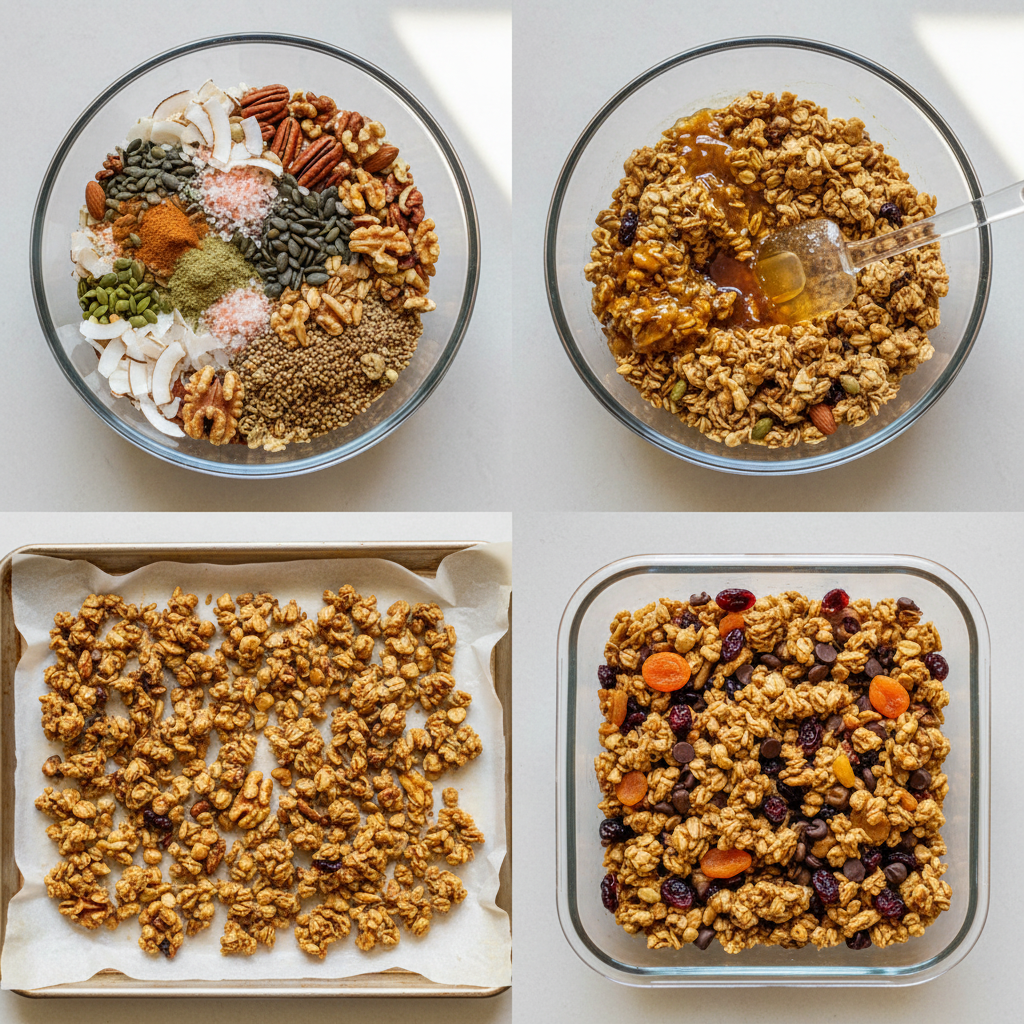
When granola is made with integrity — meaning real oats, quality nuts and seeds, a restrained amount of natural sweetener, and a good oil — the nutritional profile is genuinely strong.
Oats are the foundation, and they earn that position. Rolled oats are one of the best dietary sources of beta-glucan, a soluble fiber that has been extensively studied for its effect on LDL cholesterol. Regular consumption of oat beta-glucan is associated with measurable reductions in "bad" cholesterol levels, improved blood sugar regulation, and a reduced risk of cardiovascular disease — enough so that the FDA approved a heart health claim for oat products back in 1997. Beyond beta-glucan, oats provide sustained-release carbohydrates that fuel steady energy rather than a spike and crash, along with B vitamins, iron, magnesium, and zinc.
Nuts and seeds — whether almonds, cashews, walnuts, pumpkin seeds, or sunflower seeds — contribute healthy unsaturated fats, plant-based protein, and a concentrated source of micronutrients. Almonds are particularly high in Vitamin E and magnesium. Walnuts are one of the richest plant sources of omega-3 fatty acids, specifically ALA, which supports brain and cardiovascular health. Pumpkin seeds carry a notable amount of zinc, important for immune function and tissue repair. The specific combination matters, which is why a thoughtfully built granola recipe is nutritionally more complete than one that uses a single nut for convenience.
Natural sweeteners — typically honey or maple syrup in quality granola — behave differently in the body than refined sugar. They contain trace minerals and antioxidants absent in processed sweeteners, and they have a slightly lower glycemic impact. More practically, they're used in smaller quantities to achieve the same sweetness, which means a well-made granola is genuinely lower in added sugar than its commercial counterparts — not as a marketing claim, but as a measurable fact.
For people with gluten sensitivity, it's worth noting that oats are naturally gluten-free. The issue is typically cross-contamination during processing. When granola is made with certified gluten-free oats — as it should be in any kitchen serious about dietary integrity — it's a safe, nourishing option for people who have otherwise had to avoid traditional breakfast grains.
From a satiety standpoint, the combination of fiber, fat, and protein in well-made granola is one of the more effective ways to start a day with real staying power. It doesn't spike blood sugar and leave you hungry by 10am. It delivers slow-burning energy that holds — which matters considerably more than calorie counts for anyone managing energy, performance, or weight over the long term.
Why Granola Belongs in a Clean Meal Program
There's a version of "healthy eating" that feels like deprivation — smaller portions, blander food, a constant negotiation between what you want and what you're supposed to have. That's not what Alab SF is building toward, and granola is a good illustration of why.
Real granola — made with organic oats, quality nuts, a touch of honey or maple, and nothing else that doesn't need to be there — is food that's genuinely good and genuinely good for you at the same time. It doesn't ask you to compromise. It's satisfying in the way that whole food is satisfying: not just filling, but nourishing in a way you can feel.
That's the standard Alab SF holds every ingredient to, whether it's a grain, a green, a sauce, or a topping. The weekly menu is chef-crafted, built around organic ingredients, and designed to make clean eating feel like abundance rather than restriction. Granola, in the right hands, is exactly that — a food with real history, real nutrition, and real flavor that makes a bowl feel like something worth sitting down for.
A Closing Note
Food made with care has a way of showing — in the texture, the flavor, the way it holds up through the week, the way you feel after eating it consistently. That's what Alab SF is here for.
We're looking forward to welcoming you into the community and to serving you the kind of healthy, delicious food that makes the week feel a little more taken care of. Whether granola is your go-to or just something you've been meaning to try again — the right version of it is waiting for you.
Come find your table with us.
Alab SF delivers fresh, chef-crafted organic meals weekly across the Bay Area. Gluten-free, dairy-free, and made for real life. See what's on the menu this week → Alabsf.net.
